
Notes from an editor
Psst. Hey you. Writer. I know you think you don't need an editor, but—hey, look at me, yeah you—I've got something to tell you. Come here. Yeah. A little closer. Yeah that's good. Now listen up ...

Today’s post is mostly for writers so if you’re not interested in that kind of malarkey then I’ll see you in two week’s time about something less worky.
Last year sometime while I was still self-harming by attempting to understand the cult of personality cesspit that is Threads (sorry Threads lovers) I saw a post by an author complaining that their editor had left unkind words on their manuscript.
Unkind words like ‘sloppy’, ‘disorganised’, ‘please review this’.

The author complained—and I’m paraphrasing heavily here but the vibe is legit—that her editor had sent the manuscript back saying that she didn’t like being sent half-written work.
The author was expressing to her Threads supporters that this was harsh and unfair and that it was a first draft, a sort of ‘thinking document’, and that she’d expected to brainstorm what she had with her editor. A sort of ‘write the story with her’ kind of thing.
Naturally, all the OP’s Threads friends—editors and writers alike—agreed with her and soothed her and told her what a meanie the editor was.
Friends. The scream in which I screamt. I had to throw my phone across the room to stop myself from unleashing a series of beastly snarls and terse one-liners, or a mini thesis even, about why her editor was right.
Instead of responding, I nursed a few grains of snarky one-liners until the nacre of time and thought produced a nice little pearl or three of actually useful information for writers who don’t know the first thing about the editing process.
Because there are many writers who don’t know anything about editing and why would they? Newbies to the publishing process aren’t expected to know what’s what.
We all learn as we go. So here are some breakdowns …
What editing is what now?
Developmental editing (or structural editing) This is working on the structure, the bones of your narrative, the character, plot, dialogue, the arc, internal story coherence … dev editing asks, ‘does it all work, are there any saggy bits, problem children, plodding dialogue, nonsense logic?’ … It’s crazy intensive and is notably more expensive than line editing. $$$
Line editing (or copy editing) This is working at the line level: is this sentence grammatically correct, does it make sense, is it good? Line editing is fact and coherence checking, it’s hunting down word overuse and silly phrases. Catching spelling mistakes is the least of what this is. Most dev eds will end up doing a lot of line editing, but you can’t bank on this. $$
Proofreading. This is the final check on your document. This catches all those spelling, formatting and grammar slips. $
If you’re self-publishing and you have all the cash, you’re going to spend on all three. If you have only medium monies, you’re going to spend it on a very good line editor (and then not touch a thing after everything’s ‘signed off’). If you have little monies, you must at least try for a proofreader.
What editing do you actually get with a trad publisher?
To OP’s original gripe: If your fiction trad publisher is paying for any editing at all they’re paying for line editors—and they’re paying less and less for this these days.
If an author is lucky, they get a line editor who comments on dev edit matters; if they’re unlucky, they get a line editor who barely does a spellcheck (true story).
These days, local trad publishers can only really afford to pay dev editors if they’re certain they’re going to make their money back (and then some). For the most part, they—the publisher or commissioning editor—might get personally involved and make some suggestions to the author for changes, but otherwise it’s a line edit and proofreader and off you go. And if you have the misfortune of being assigned a not great line editor, too bad for you.
In the robust book industry of the global north, publishers don’t typically deal with authors. They have agents and editors for that. And even so, before the editor sees any work it’s already been through an agent who has already done some dev work on the manuscript to get it sold and, even so, for the most part, the agent has plucked this manuscript up from the teetering slush pile because it was already the most well-written of whatever it is they’re looking for (i.e. been through some kind of editorial process).
This is why all hopeful authors are advised to work relentlessly on their manuscripts before they send it out to agents or, here in South Africa, to publishers. You can’t just first draft it, think you’ve written gold, and start querying.( Edit: Unless you have a high concept story, in which case no one will care—something I was reminded of with Yesteryear and the Call me, I’ll hide the body fiasco. This substack is a great read by Karin Gillespie explaining all of this. Unsurprisingly, it’s made me feel worse about my own writing and the fact that I am almost certainly never going to find a trad publisher.)
In OP’s case it’s possible she thought she was getting a developmental editor working with her from first draft to last, when in fact her publisher had given her a line editor.
Split realities
In my experience there are two kinds of writers: the kind who thinks their work is perfect and needs no editing and the kind who dreams of working closely with an editor who will care about their book as much as they do (like OP). Both are problematic in their own ways.
The former because they’re wrong and that awakening is going to be hard on them and everyone around them. The latter because you will probably only get this experience if you pay for it yourself and it is expensive.
Sadly, I don’t have advice for the latter other than you can probably work out a payment plan with a dev ed you like. I know many people would say ‘oh join a writing group where other writers can give you advice for free’ and to that I say ‘be careful’.
It is possible you have a writing group of experienced writers willing to be honest; it is possible each of these writers holds no personal agenda and cares deeply about story as it pertains to story—not to their kind of story—it is possible they understand the difference between writing and story, it is possible they push you where you need to be pushed and care enough to push you even when it’s challenging …
All of this is possible. But not probable.
For the former kind of writer: accept in your soul that while not all manuscripts will need a developmental editor, all manuscripts will need a line editor. I like to show this in my writing workshop.
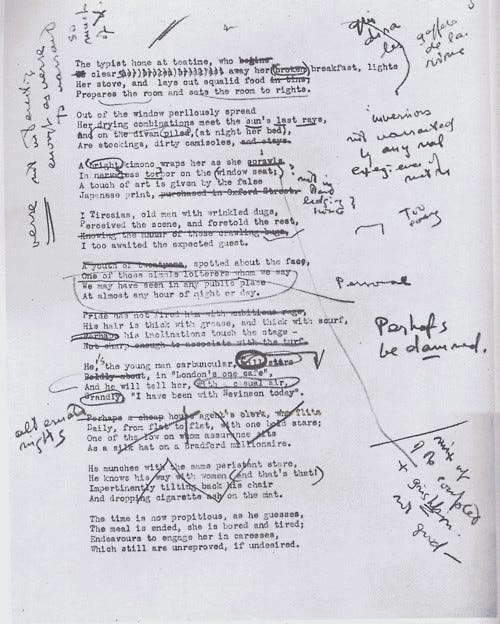
If T.S. Eliot can endure an edit, so can you.
I will add, though, that I think a lot more commercial fiction authors (as opposed to literary fiction authors) need a developmental editor than probably realise.
Storytelling comes naturally to some writers and some writers need to learn. This isn’t an indictment on your talent. It’s a craft and all crafts need time and support and mentors. Sometimes you can work by yourself to learn, sometimes you need help. It’s quicker with help.
Interestingly, the authors I’ve worked with that are most open to this are usually older and have a little more life experience. Young authors, especially new ones, are fuelled by ego and delusions of grandeur (I mean, par for course, right?), and are now supported by a publishing ecosystem that tells them it’s all about YOU, baby. If YOU shine your books shine. YOU are the locus of reader interest. The work seems almost secondary.
Maybe it is now and maybe I need to catch a wake up. But I don’t want to. As a reader I care about the writing and the story; as a writer I care about the writing and the story. As an editor I care about you as a writer and your ability to write and tell a story.
Time and money: the great investment
This may seem like a plug, and it is and it isn’t. It’s something that came to me just the other day while I was writing about those authors who pitch book after book after book to agents, waiting years to get picked up.
My advice to them was rather to self-publish all those manuscripts that don’t get signed.
Go through the active learning process: learn, evolve, get smashed in the face with what’s working and what isn’t. Get completely fucked up by learning, rather than getting completely fucked up by pitching forward blindly in the dark, rejection after rejection.
Just because you’ve self-published doesn’t mean your future books won’t get signed to a trad publisher if that’s what you want.
And if you want to take a massive leap in your learning curve? Get a manuscript assessment or team up with a developmental editor.
You can spend your time, years in fact, trying to figure out what’s wrong with your work and why it’s not getting signed or why it’s not resonating, or you can spend some money and have someone tell you what you need to work on.
Which brings me to …
I see a lot of negative comment about the 'industry’ that’s been made around writers: pay for workshops, pay for editing, pay for manuscript assessments, pay for this, pay for that ...
But paying for an MFA is fine? Paying for upskilling in any other profession is perfectly acceptable? Even hobbyists and crafters spend money on what they like. People who like cycling or running or camping … there are entire industries built to support this. Why do writers get shafted if they want support or give it?
I also know that most of the writers offering these services are not a fuck charging what their time and knowledge is actually worth. I saw one the other day who was and I nearly fell off my chair.
So. Here’s the plug: If you want to up your game as a writer, whether you’re self or trad published, especially if you’re stuck, especially if you’re uncertain, look at getting a manuscript assessment (a good one will offer dev notes anyway) or consider working with a developmental editor.
Either will save you time and money in the long run.
Doesn’t have to be me. There are many, many people offering these services.
But if you are interested in seeing what I do, you can check out my website here > tanyameeson.com < and get in touch on the contact form. Or just message me on the button below.
‘til next time,
Keep it TIGHT.
t
A manuscript without and editor is like a dance without music
Um... I might be messaging you in the near to distant future.